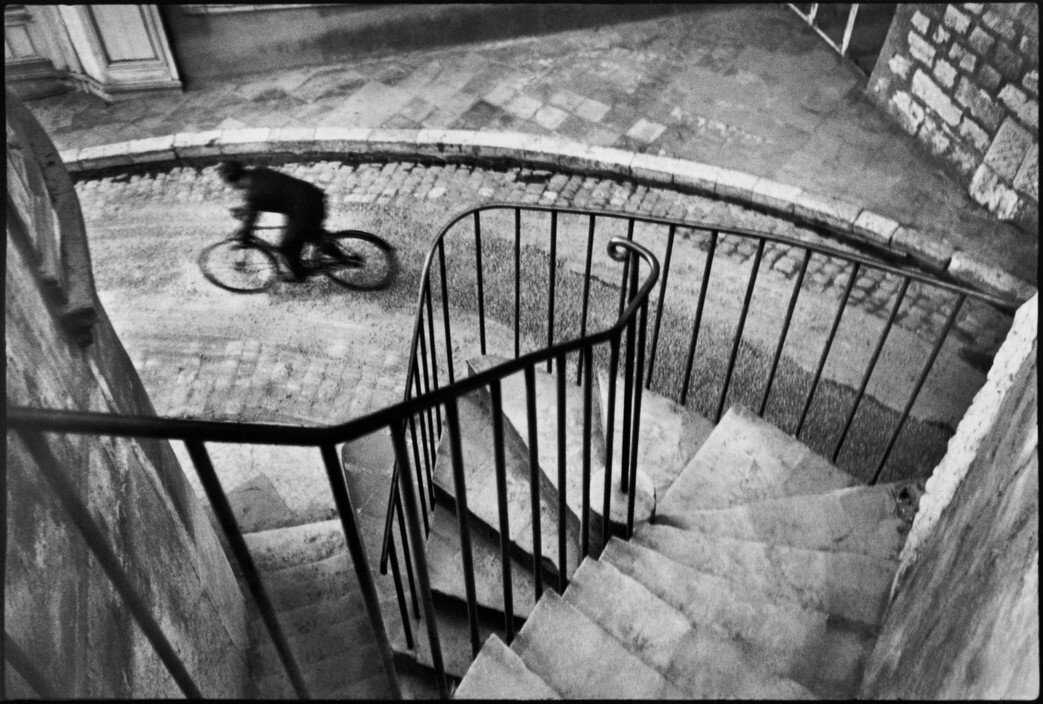
The older framing asked what Henri Cartier-Bresson would think of photography today. In 2026, the more honest answer is that we cannot know. We can, however, use his practice to sharpen the question.
Cartier-Bresson's biography is inseparable from walking, timing, geometry and historical presence. He moved through the 20th century with a camera in situations that demanded physical attention. That does not map neatly onto generative AI, where images can be produced without a scene, a body or a moment.
The useful contrast is not moral panic. It is phenomenological. Photography traditionally involves being there, even when the final image is edited, printed or sequenced later. AI image generation can produce convincing photographic surfaces without that encounter. That difference matters for documentary truth, memory and trust.
A 2026 reading should not turn Cartier-Bresson into a slogan. His work can remind us that timing and form are not only visual effects. They are the result of a photographer meeting the world under specific conditions.
The decisive moment after AI
The decisive moment is often misunderstood as fast reflex. It is better understood as alignment: body, scene, geometry and time coming together.
Synthetic images can imitate that look, but they do not automatically contain that encounter.
What editors should ask now
Where was the image made? Who made it? What was generated, altered or staged? What context is missing?
Those questions are not bureaucratic. They are now central to photographic literacy.
Why this cultural piece belongs here
Photography is not only equipment, and "Cartier-Bresson, AI and the Decisive Moment in 2026" belongs in the archive because image culture shapes what cameras are asked to do. Exhibitions, books, films, AI disputes and photographer writings all change the expectations around the tools themselves.
A technically serious photography site needs this layer. Without it, cameras become isolated consumer objects. With it, gear coverage connects back to memory, authorship, attention, public trust, artistic risk and the social life of images.
How to use this article
Read this kind of essay as a way to sharpen judgment rather than as a direct buying guide. It can influence what you photograph, how you edit, which projects feel worth continuing, and how you interpret the flood of images produced by phones, cameras and generative systems.
The practical value is slower but real. Better photographic taste changes equipment decisions too: it makes a photographer less vulnerable to hype and more aware of the kind of work a tool should help make.
That is the reason cultural articles sit beside camera reviews here. They give the technical archive a point of view, and they remind readers that image quality is never only a property of a sensor. It is also a property of attention.
Sources cited in this article
These links are included so readers can inspect the source material, official product pages, public records, or reporting used for this story.
- Fondation Henri Cartier-Bresson: biography henricartierbresson.org
- U.S. Copyright Office: Copyright and Artificial Intelligence copyright.gov