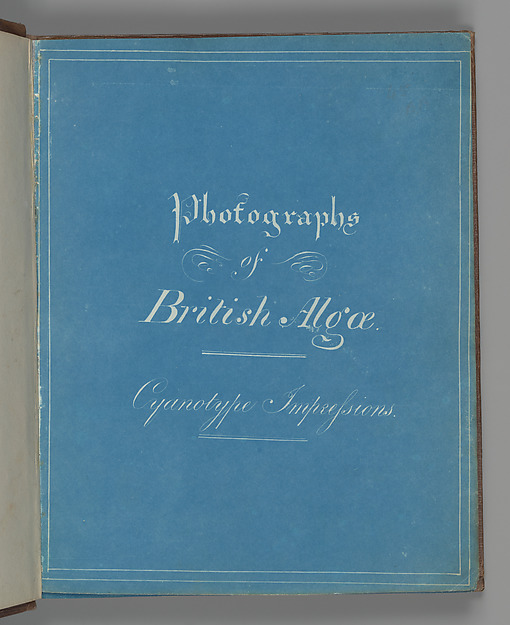
Before photography became a culture of cameras, lenses and shutters, Anna Atkins made a book out of light, chemistry and seaweed. The result was blue, scientific, handmade and quietly radical.
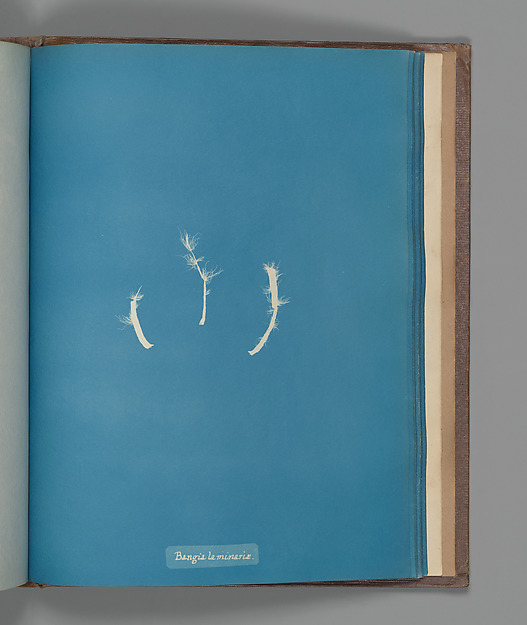
The curiosity is simple enough to sound impossible: one of the first books illustrated with photographs was not built from street scenes, portraits or landscapes. It was built from algae. Atkins placed botanical specimens directly onto paper coated for the cyanotype process, exposed them to light, and left behind white silhouettes floating in deep Prussian blue.
Her project, Photographs of British Algae: Cyanotype Impressions, began in 1843 and continued into the 1850s. The Metropolitan Museum of Art dates its album to 1843-53 and identifies the medium as cyanotypes. What looks today like a minimal art object was also practical scientific work: Atkins wanted to record plant forms with a precision drawing could not always guarantee.
That is what makes the story useful for photographers now. Atkins reminds us that photography was never only about cameras. From the beginning, it was also about contact, evidence, surfaces, experiments, classification and the strange beauty that appears when a technical process is pushed with care.
The strange method
A cyanotype begins with chemistry rather than a lens. Paper is treated with iron salts, an object is placed on the surface, and light does the rest. Where the specimen blocks the light, the paper remains pale. Where light reaches the paper, the image turns blue after washing.
That means Atkins's algae pictures are not photographs in the familiar camera sense. They are photograms: images made by direct contact. The subject does not sit in front of the camera. It touches the image surface. The photograph becomes both record and imprint.
This is why the work still feels fresh. A thin piece of seaweed becomes a drawing made by light, a scientific diagram, a design object and a photograph at the same time.
Why algae?
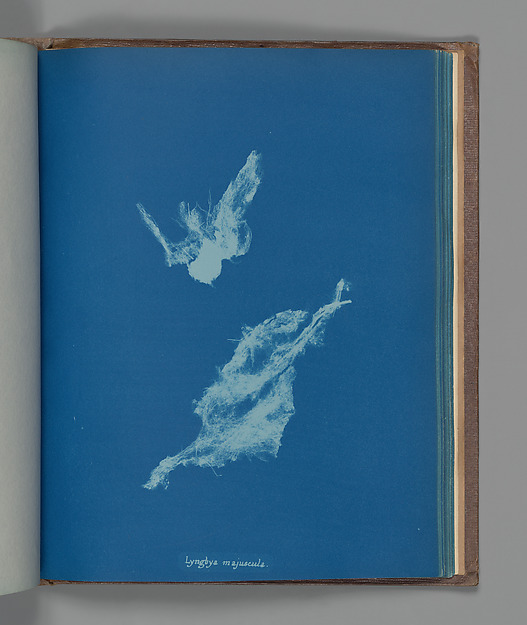
Algae were difficult subjects for ordinary illustration because their forms are delicate, branching and easy to distort. Cyanotype let Atkins keep the outline, scale and structure of the specimen with unusual directness.
The choice also connected her to the scientific culture around her. Atkins was not treating photography as a novelty trick. She was using a new imaging process to solve a problem of documentation.
The result is why the book matters beyond botany. It shows photography becoming useful before it became familiar. Atkins found a use case where the medium's limitations were exactly its strength.
The blue is not decoration
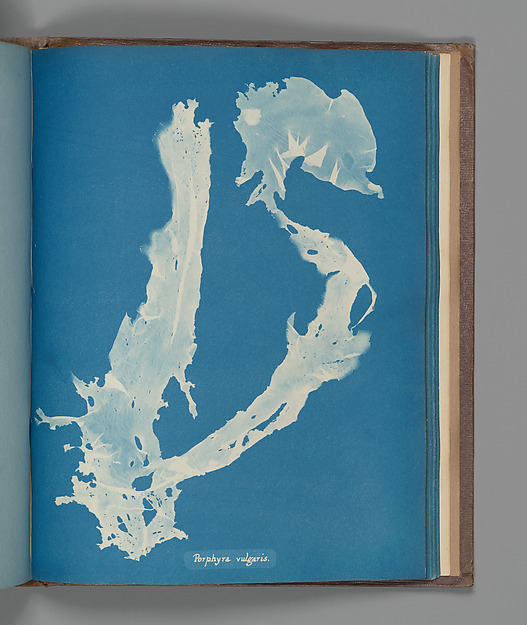
The deep blue is part of the cyanotype process, not a later style filter. That color now makes the pictures instantly recognizable, but it also carries the history of the method. The image is blue because the chemistry is blue.
For a contemporary viewer, that can make the pages feel oddly modern. They look close to graphic design, textile pattern, abstraction and scientific plate all at once. Atkins was not trying to make modern art, but the work keeps arriving there.
That gap is the pleasure of the archive: a document made for one reason can survive because it keeps producing other meanings.
A photographer without the usual camera myth
Atkins is useful because she breaks the heroic camera myth. The photograph here is not the instant, the chase, the street, the decisive moment or the dramatic portrait. It is a patient contact between specimen and prepared paper.
That does not make it less photographic. It expands the word. Photography can be a machine held to the eye, but it can also be an experiment conducted on a table.
The lesson is especially sharp now, when photography is again being stretched by software, sensors, archives and computational tools. Atkins shows that the medium has always changed by absorbing new procedures.
Why this curiosity matters now
The Atkins story is not only a historical footnote. It is a reminder that a photograph can be useful, beautiful and conceptually strong without behaving like a conventional picture.
It also gives Photography Today a better kind of archive story: one where a technical process, a visual result and a human decision meet. The point is not only that Atkins was early. The point is that she understood what a new medium could do before the culture around it had fully named the possibilities.
That is the curiosity worth keeping: the first great photobook was blue because it was made by light touching plants.
Sources cited in this article
For "Anna Atkins: The Photographer Who Made the First Photo Book in Blue," these sources ground the cultural argument in public records, archives, exhibitions, project material, or reporting.
- The Metropolitan Museum of Art: Photographs of British Algae: Cyanotype Impressions metmuseum.org
- The Metropolitan Museum of Art: Bangia laminarae metmuseum.org
- The Metropolitan Museum of Art: Lyngbya majuscula metmuseum.org
- The Metropolitan Museum of Art: Porphyra vulgaris metmuseum.org
Photography history and visual literacy
Photobooks, archives, photographer voices, exhibitions and the older ideas that still shape how cameras are used.
- Sergio Larrain's Letter to a Young Photographer: Walk First, Photograph Later Inspiration
- Cartier-Bresson and the Decisive Moment in the Digital Age Inspiration
- Photography Books for Visual Literacy in 2026 Inspiration
- MoMA New Photography 2025: Lines of Belonging After the Show Inspiration
- Perfect Days and the Compact Camera in 2026 Inspiration