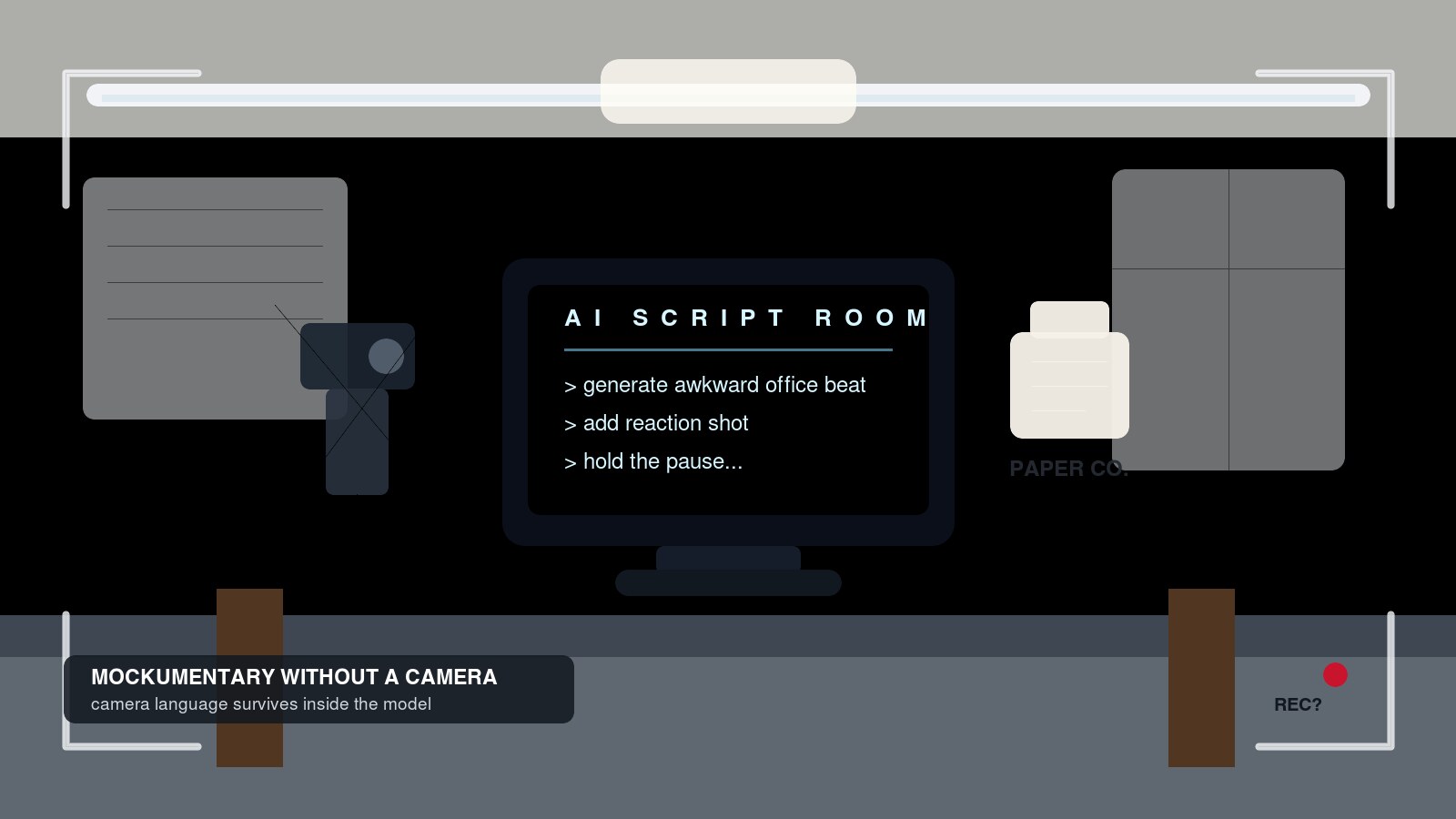
The viral office-comedy clip that circulated around Claude was not franchise news. The photographic point is sharper: generated video can now imitate camera grammar without recording a scene.
The clip worked because it understood a visual language viewers already know: deadpan framing, office fluorescents, awkward pauses, reaction shots and the sense that a documentary crew happened to catch something slightly embarrassing.
That pushes the story beyond novelty. Generated video can simulate the look of a filmed scene, but it still leans on decades of camera decisions: lens perspective, blocking, handheld timing, interview framing, exposure habits and editorial rhythm.
For photographers and filmmakers, the question is not whether cameras disappear. The sharper question is what happens when camera language becomes detachable from camera capture.
Why the clip mattered
The source trail points to a viral post and a Reddit discussion, not an official television release. That distinction keeps the article grounded and avoids treating a proof of concept as industry news.
Even so, the experiment lands because the style is legible. Viewers understand the workplace mockumentary before they understand the model.
Why mockumentary style is easy to imitate
A workplace mockumentary is not built on spectacle. It is desks, bad conference rooms, talking heads, side glances and tiny changes in social temperature.
That visual economy makes it revealing. A model does not need a huge fantasy world to feel disruptive. It only has to stage a recognizable room, hold a face long enough and imitate the rhythm of a camera waiting for awkwardness.
The new era is not beyond cameras
The better answer is stranger: the new era may be after cameras, but not beyond camera language. A generated scene still thinks like a camera. It has a viewpoint, a frame, a cut, a simulated lens and a sense of where the viewer is standing.
That means camera culture survives inside the model. The AI image looks new only because decades of cinematographers, documentary crews, editors and photographers taught audiences how to read a shot in the first place.
What cameras still do better
The weak points are still visible: mouth movement, timing, eye behavior, body weight, improvisational looseness and the exact social temperature that makes workplace comedy feel alive. The camera records accidental truth. AI video still tends to synthesize an idea of truth.
That gap matters. A real camera does not only make images; it puts bodies, rooms, light, performance and chance under pressure at the same time. Comedy especially depends on pressure. A generated clip can mimic the surface, but performance is still a physical event.
Read the AI art context
This is part of a wider shift in image culture, where authorship, prompts, style imitation and visual evidence keep colliding.
For the legal and cultural side of AI-generated imagery, read our piece on the Theatre D'opera Spatial copyright case.
Where this hits first
The first industry impact is unlikely to be prestige television. It will be test scenes, social sketches, ad concepts, pitch decks, parody videos and rapid visual drafts. These are places where the point is speed, not perfect performance.
For camera makers, the long-term warning is clear. If more moving images are generated from prompts, cameras have to defend what only capture can do: trust, presence, real light, real bodies, physical location and the unpredictable evidence of being there.
The camera is still inside the synthetic image
AI video belongs in a photography publication because it borrows decades of camera grammar: lens behavior, handheld rhythm, sitcom blocking, zoom language, focus cues and the emotional authority of recorded scenes.
The critical question is disclosure. A generated clip can imitate the signs of filming without any filmed event behind it, so the article has to separate technical fascination from the reader's need to know what kind of image they are looking at.
Sources cited in this article
For "AI Video and the Camera Language It Borrows," these sources ground the cultural argument in public records, archives, exhibitions, project material, or reporting.
- Reddit: Claude's first day at Dunder Mifflin discussion reddit.com
- X: original Claude's first day at Dunder Mifflin post twitter.com
- Anthropic: Claude models overview docs.anthropic.com
- Peacock: The Office streaming page peacocktv.com
AI, authorship and image trust
Generated video, copyright, programmable cameras, mobile image systems and the disclosure problem around synthetic images.
- Theatre d'Opera Spatial and the AI Copyright Case Inspiration
- The Poetry Camera: Elias Sarquis, Raspberry Pi and a Camera That Writes Inspiration
- Cámara Poética iOS App in 2026: When Photos Become Poems Inspiration
- Raspberry Pi AI Camera in 2026: Why Programmable Cameras Matter Camera News
- Wearable Cameras in 2026: Photography, Privacy and the New Viewfinder Camera News