The most important eclipse accessory is not a newer camera. It is a rehearsed procedure that protects the photographer, the equipment and the few unrepeatable moments of totality.
On August 12, 2026, the Moon’s shadow will cross northern Russia, Greenland, Iceland, the Atlantic, Spain and a small corner of Portugal. NASA says most locations inside the path will receive less than two minutes of totality; the Associated Press reports a maximum of two minutes and 18 seconds west of Iceland. Much of Europe, northwestern Africa, Canada and part of the northern United States will see only a partial eclipse.
That geography creates an unusually demanding photographic event. Greenland and Iceland encounter totality in the late afternoon or early evening, while Spain and northwestern Portugal receive it shortly before sunset. Editorially, that favors deliberate horizon-based compositions, but it also makes distant terrain, buildings, haze and cloud more consequential than they would be with a high Sun.
Safety rules change only for the brief interval when the Sun’s bright face is completely covered. The American Astronomical Society says an uneclipsed or partially eclipsed Sun must not be observed through unfiltered cameras, binoculars or telescopes. A filter for magnifying optics must be secured over the front of the lens, and the society advises consulting an expert astronomer about an appropriate optical filter.
For photographers, the useful plan is therefore procedural: calibrate exposure beforehand, focus and frame before first contact, rehearse removing and replacing the filter, and reduce the number of decisions required during totality. The event is too short for menu exploration, lens changes or an improvised attempt to learn exposure bracketing.
Build the safety sequence before the exposure sequence
ISO 12312-2 covers filters intended for direct, unaided observation of the Sun, including eclipse viewers. It should not be treated as a blanket specification for an improvised camera filter. The AAS separately warns that concentrated light from magnifying optics can damage an inadequate filter and injure the viewer. Eclipse glasses worn at the eye do not make it safe to look through an unfiltered optical viewfinder, lens or telescope.
For the partial phases, use a purpose-made solar filter that fully covers the front of the lens and cannot be dislodged by wind or handling. Nikon’s eclipse guidance specifically warns against placing a solar filter in the rear filter slot of a large telephoto. Inspect the material for punctures, scratches, tears or loose edges, and use the rear screen rather than an optical finder when practical. If a suitable filter and a reliable attachment method are not already available, skip direct solar imaging and photograph a pinhole projection, crescent-shaped shadows or the observing crowd instead.
Calibrate the filtered camera before August 12
Nikon recommends testing on the uneclipsed Sun before the event, with the actual filter, lens and camera. Its published starting procedure fixes an aperture between f/8 and f/16, then tests shutter speeds from 1/4000 second to 1/30 second. Those values are a calibration range, not a universal prescription: filter transmission, cloud and atmospheric haze can change the result. Record the successful setting rather than trusting memory.
Use RAW capture if the camera offers it, inspect the histogram for clipped highlights and confirm focus manually at high magnification. Tape the focus ring if the lens is easily disturbed. A sturdy tripod and remote release reduce vibration, but stabilization behavior varies by system; verify the chosen tripod settings in advance. What has not changed is more important than any recent camera feature: autofocus recognition, computational processing and a bright electronic viewfinder cannot substitute for correct filtration or a rehearsed manual workflow.
Treat totality as a controlled mode change
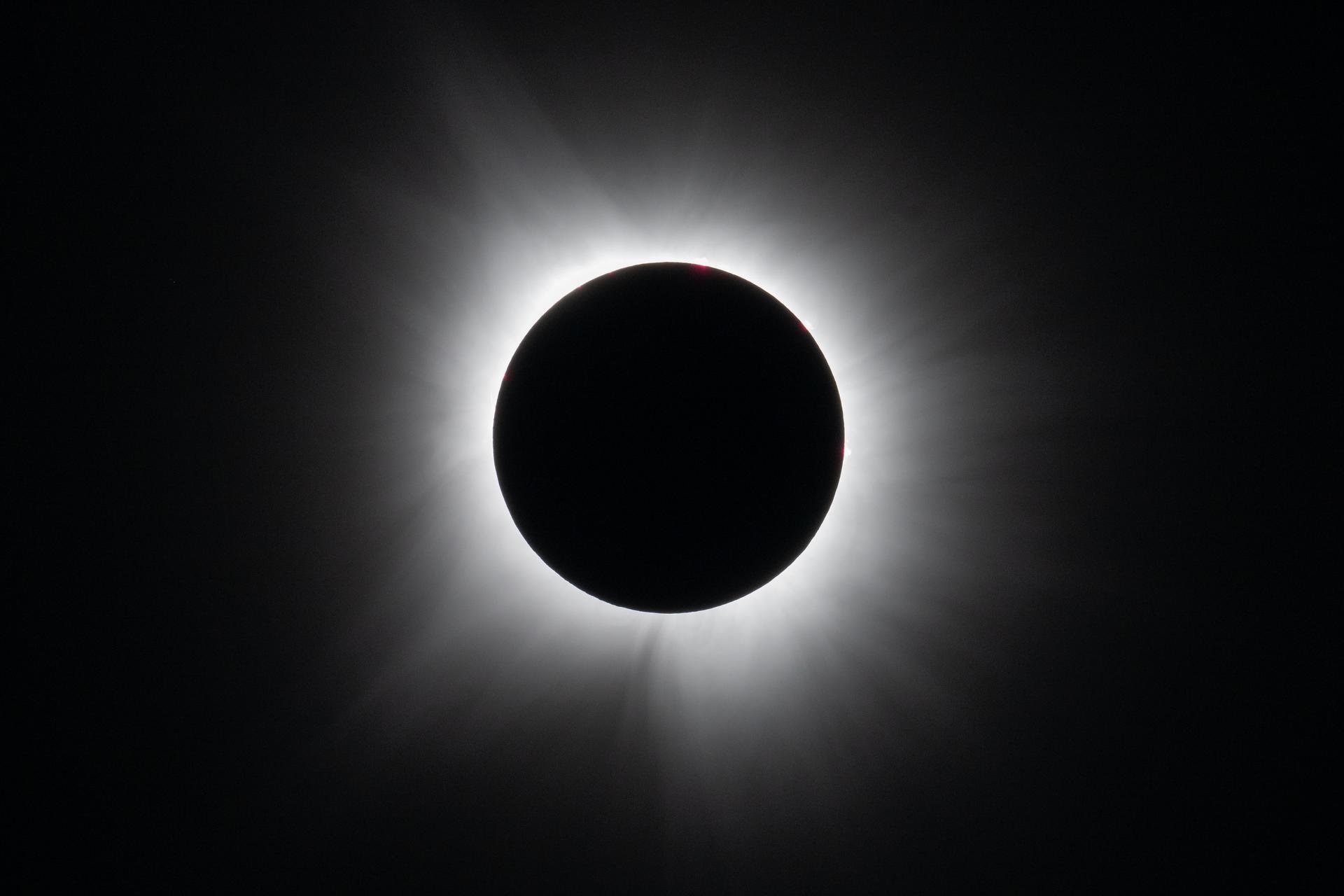
During totality, the corona becomes the subject and the exposure problem reverses. Nikon notes that the corona is roughly a million times fainter than the visible solar disk and cannot be photographed through the strong filter used for the partial phases. Once the Sun’s bright face is completely covered, remove the lens filter, switch to the prepared totality settings and begin the bracket. Replace the filter before the first bright sunlight reappears.
No single exposure records the full brightness range from the inner to the outer corona. Nikon’s guide proposes keeping one aperture and bracketing shutter speeds from 1/1000 second to one second, with additional one- or two-stop bracketing where appropriate. This is a starting framework rather than a guaranteed exposure. Save it to a custom mode or written card, rehearse the button sequence, disable unnecessary review delays and make the return to the filtered partial-phase mode part of the same drill.
Choose between solar detail and a sense of place
Scenario one is the specialist close-up: a long lens on a rigid support, manually focused and framed with enough margin for tracking error and the extended corona. The photographer calibrates the filtered partial phase, then runs a prepared unfiltered bracket during totality. Nikon advises staying at or below 1400mm on full frame, or 900mm on its DX format, when the goal includes the corona. Longer effective framing risks cutting off its outer structure and makes alignment less forgiving.
Scenario two is an environmental eclipse photograph in northern Spain: a wider lens frames the low, late-evening eclipse with a ridge, coast, architecture or observers. Because NASA says totality occurs shortly before sunset there, this approach can communicate location and scale while tolerating less precise tracking. The tradeoff is a much smaller solar disk, more complicated foreground exposure and greater dependence on an unobstructed horizon. A second unattended camera can record that context, but only if it has been fully rehearsed; otherwise, two bodies merely double the failure points.
Who should simplify, wait or choose an alternative
Photographers outside the path of totality must keep the solar filter in place for the entire event. There is no safe or photographically useful unfiltered corona interval during a partial eclipse. For them, the stronger project may be a sequence of the changing solar crescent, a filtered telephoto image aligned with a landmark, or indirect projections beneath trees and perforated objects. NASA will also stream the eclipse for anyone defeated by cloud or location.
Do not buy a new camera solely because this eclipse is approaching. A familiar RAW-capable body with dependable manual controls is more useful than an unfamiliar flagship, and renting a lens only makes sense if there is enough time to practice the complete filtered workflow. Photographers who cannot test their filter, secure it to the lens or identify the transition into and out of totality should skip the direct close-up. Those who value the experience more than the file should use one simple, automated composition—or put the camera down during part of totality. Weather remains the largest uncontrolled limitation, and no equipment purchase changes it.
Sources cited in this article
For "Photographing the August 12 Total Solar Eclipse: A Safer Field Plan," these sources ground the cultural argument in public records, archives, exhibitions, project material, or reporting.
- NASA Science — Total Solar Eclipse on August 12, 2026 science.nasa.gov
- NASA Scientific Visualization Studio — Map of the August 12, 2026 Total Solar Eclipse svs.gsfc.nasa.gov
- American Astronomical Society — How to View a Solar Eclipse Safely eclipse.aas.org
- ISO — ISO 12312-2:2015 Filters for Direct Observation of the Sun iso.org
- Nikon USA — How to Photograph a Solar Eclipse nikonusa.com
- Associated Press — August’s Total Solar Eclipse Will Sweep Over Spain, Iceland and Greenland apnews.com
- NASA Science — 2024 Total Solar Eclipse Image and Credit Record science.nasa.gov