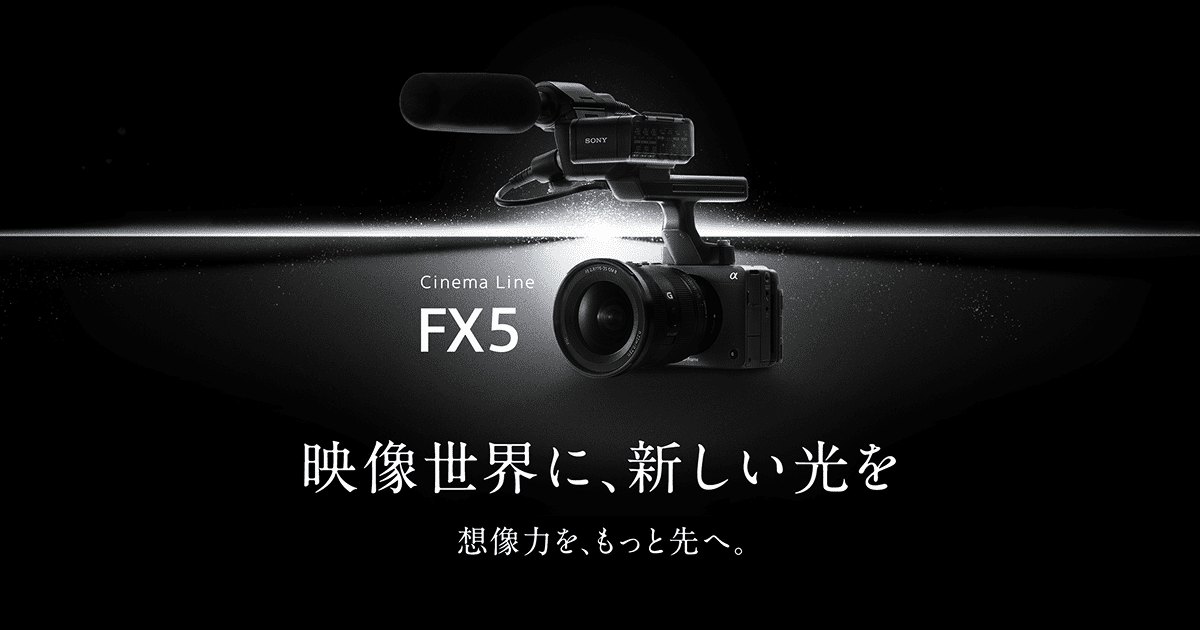
Demand is building around Sony’s compact cinema camera, but its launch configuration deserves more attention than its preorder queue.
Sony Marketing in Japan issued a supply notice on July 28 saying FX5 orders had substantially exceeded its expectations and warning that delivery could take longer than anticipated. The statement applies directly to the Japanese market; it does not establish a worldwide shortage or provide revised shipment dates. Sony Electronics still lists the US body at $4,899.99 and originally scheduled availability for mid-August.
The demand is understandable. Announced on July 22, the FX5 combines a fully stacked full-frame Exmor RS sensor with internal X-OCN RAW, 3:2 open-gate acquisition, three selectable base ISO settings and a cinema-focused interface. It occupies the practical space between a stripped-down mirrorless-style body and a larger production camera.
The important buying question is not whether those specifications are impressive. It is whether a crew can use the formats, accessories and software available at launch. Several headline modes are assigned to later firmware, open gate initially depends on Sony’s RAW workflow, and the compact body omits production conveniences that remain valuable during unscripted work.
No hands-on conclusions are claimed here. The assessment combines Sony’s published specifications and supply notice with independent reporting from CineD, Newsshooter and Digital Camera World, including clearly identified observations made with preproduction equipment.
What the supply notice actually says
Sony’s Japanese notice is narrow but significant: orders opened there on July 28, demand exceeded the company’s forecast by a wide margin, and some deliveries may take time. It does not quantify orders, identify a manufacturing constraint or connect the warning to any particular component. Reports attributing the situation to a specific factory or sensor problem therefore remain unconfirmed and should not guide a purchase.
For working crews, the sensible response is logistical rather than emotional. Do not schedule a paid production around an unconfirmed delivery estimate, sell a functioning A-camera before the replacement is physically inspected, or pay an unofficial premium merely to move forward in a queue. A refundable preorder may preserve options, but rental availability and a backup body should remain in the production plan until regional dealers provide firm allocations.
The useful change is a taller, RAW-centered negative
At launch, the FX5 records 5K open gate at up to 60 frames per second using the full 3:2 sensor area, but Sony limits that mode to X-OCN. The camera also offers 17:9, 16:9 and Super 35 scan modes, while conventional 4K reaches 120p and Full HD reaches 240p. X-OCN is recorded internally as 16-bit scene-linear RAW in LT, C1 or C2 variants, removing the need for an external RAW recorder.
That taller frame has a concrete benefit for a commercial crew asked to deliver one landscape advertisement, one square placement and several vertical clips. Keeping more image height gives the editor room to reposition a presenter or product without rotating the camera or sacrificing as much resolution. An anamorphic production can also monitor lenses with 1.3x, 1.5x, 1.6x, 1.8x or 2.0x de-squeeze. It remains a compositional safety margin, however, not permission to frame carelessly: lighting, microphone placement and set edges must cover the larger recorded area.
Post-production and media are part of the purchase
Internal RAW simplifies the physical rig while transferring complexity to media management. Newsshooter reports 5K open-gate 24p data rates of 712 Mb/s for X-OCN LT, 536 Mb/s for C1 and 429 Mb/s for C2. It also notes that X-OCN calls for VPG400-certified CFexpress Type A cards. The camera has two hybrid CFexpress Type A/SD slots, but crews should verify each chosen resolution, frame-rate and codec combination rather than assuming an existing SD-card kit can sustain it.
Consider a documentary team returning with several hours of interviews and observational footage each day. Internal C1 or C2 can keep the handheld package compact, but the production still needs enough certified cards, fast readers, verified backups and editing storage. CineD’s preproduction review encountered limited application support while testing; the article was later updated to say Adobe had added the new FX5 X-OCN variants to Premiere Pro Beta. Beta support is not the same as an approved production pipeline, so prospective owners should download representative files and test decoding, proxies, relinking, grading and archival restoration on their actual workstations.
The body is compact, but the complete rig has compromises
The FX5 body costs $4,899.99 in the United States, while Sony’s package with the XLR-H2 handle is $5,499.99. The handle provides two XLR/TRS inputs, as many as four audio channels and recording up to 96 kHz in 32-bit float. Sony also offers a detachable OLED viewfinder, but the viewfinder and XLR handle cannot be used together because both depend on the Multi Interface Shoe. Buyers must therefore price the working configuration, not merely the body.
What has not changed is equally important. The FX5 remains an E-mount, video-only camera rather than a stills hybrid. It retains in-body stabilization, active cooling and a cage-friendly body with multiple mounting points, but it has no internal ND filter. A solo operator moving repeatedly between a dim interior and sunlit street must consequently manage screw-in filters, a matte box or aperture and shutter compromises. Crews dependent on SDI infrastructure or built-in electronic ND should compare the FX6 rather than assuming the newer compact body supersedes it.
Buy now, wait, or choose something else
Buy early if internal X-OCN, compact E-mount operation and full-frame open gate solve problems already present in paid work—and if the crew has budgeted for media, audio, monitoring and post-production. The three published base ISO settings of 800, 4000 and 12800 may be useful on controlled narrative work that moves between daylight and low-light sets, although Sony’s claimed 15-plus stops in S-Log3 should not be treated as an independent laboratory result.
Wait if the decision depends on features promised for version 2.0, which Sony schedules for August 2027 or later. The roadmap includes 5K 3:2 X-OCN at 120p, 4K at 240p, open-gate XAVC, a vertical-shooting interface and frame grabbing; Sony explicitly says specifications may change. Existing FX3 owners should skip the rush when 4K delivery, current autofocus and an established XAVC workflow already satisfy clients. Choose the FX6 for fast-changing documentary or event work that benefits more from internal ND and conventional production connectivity, or choose a true hybrid body when paid still photography is part of the assignment. The preorder warning is evidence of demand, not evidence that every filmmaker needs the camera.
Sources cited in this article
For "Sony FX5 Supply Warning: What Filmmakers Should Assess Before Ordering," these sources separate confirmed product information from editorial interpretation, market context, and buying-risk analysis.
- Sony Japan — FX5 supply notice, July 28, 2026 sony.jp
- Sony Electronics — FX5 announcement, specifications, pricing and roadmap sony.mediaroom.com
- Sony Electronics — FX5 product page and technical footnotes electronics.sony.com
- CineD — FX5 preproduction review and workflow observations cined.com
- Newsshooter — FX5 formats, media requirements and production analysis newsshooter.com
- Digital Camera World — FX3 and FX5 buyer comparison digitalcameraworld.com